This site is copyrighted, supported, and maintained by the Equal Justice Foundation.
| EJF Home | Join the EJF | Comments? | Get EJF newsletter | Newsletters |
|| DV Home | Abstract | Contents | Tables | Index | Bibliography |
| Chapter 8 — Demographics Of Domestic Violence In Colorado |
| Next — False allegations and burden on the courts by Charles E. Corry, Ph.D. |
| Back — Demographics of domestic violence in Colorado - 2010 |
Judicial districts with extraordinary numbers of domestic violence and abuse cases
Prosecution trends in the Fourth Judicial District
Recidivism and repeat offenders
District attorney Myrl Serra arrested for unlawful sexual contact and official misconduct
Twenty Second Judicial District
The relationship between domestic violence and other misdemeanors
Judicial districts with consistently fewer numbers of domestic violence and abuse cases
Other misdemeanor cases in these judicial districts
The data from 1998 (Table 39), 1999 (Table 40), 2000 (Table 42), 2001 (Table 44), 2002 (,Table 46), 2003 (Table 48), 2004 (Table 50), 2005 (Table 52), 2006 (Table 54), 2007 (Table 56), 2008 (Table 58), 2009 (Table 60), and 2010 (Table 63) make it plain that uniform standards are not being applied across the state in the issuance of protection orders and the prosecution of domestic violence cases in Colorado's twenty two judicial districts.
With thirteen years of court data it is obvious that abuse of process under color of law is occurring in judicial districts that consistently issue protection orders and prosecute domestic violence cases in per capita numbers more than one standard deviation above the average for the state's judicial districts.
From the data summarized in Table 65 the Third, Fourth, Seventh, Tenth, Twelfth, and Sixteenth judicial districts stand out as repeatedly (for more than four years) issuing extraordinary numbers of protection orders. Their abysmal records of injustice are summarized in Table 65 and these judicial districts currently (through FY 2010) encompass 23% of the sampled population of 4.4 million residents.
The Twenty Second Judicial District (Dolores and Montezuma counties) was added to Table 65 beginning in 2006 as the number of cases there suddenly jumped from 80-90 to 132 with the election of a new district attorney and has remained near the top of this list of draconian districts since.
There is always a fine line between aggressive prosecution of crime and the persecution that characterizes a police state. The seven judicial districts listed in Table 65 have crossed that line with regard to prosecution of domestic violence and abuse. These seven judicial districts appear to be in a race to see who can destroy the greatest number of children and families by imposing the most draconian enforcement criteria for domestic violence and abuse.
Leading off in the roll of infamy tabulated in Table 65 is the minuscule Third Judicial District embracing Huerfano and Las Animas counties along Colorado's southern border. With 163 per 10,000 residents being persecuted in 2010 this district continues to set a sickening standard for draconian enforcement.
This decaying hive of petty dictators rules over an ever-decreasing 22,218 Colorado residents. Things stink so bad that Huerfano County Judges Claude W. Appel and Robert E. Haeger were disciplined in October 2001 after allegations of improper judicial conduct surfaced. The Colorado Supreme Court also appointed Norman Arends chief judge after District Judge Jesse C. Manzanares was relieved because of the same allegations. A local attorney even accused the judges of using cocaine.
Apparently Appel and Haeger were “cleared” as Appel was promoted to district judge and is now chief judge of the Third Judicial District. Haeger is still a Huerfano County Court judge as well. Matters only got worse and persecution has not diminished with a record-setting 175 domestic violence and abuse cases for every 10,000 suffering citizens in 2009.
The Third Judicial District has generally led the state in the per capita underage alcohol offenses, and offenses against persons and property (Table 67) in addition to the extraordinarily high levels of protection orders.
At the current rate every man over the age of 18 who remains in the Third Judicial District will receive a restraining order by or before 2020, and over half of them will be charged with domestic violence.
The abuse of restraining orders is obvious in El Paso and Teller Counties, including the city of Colorado Springs, that comprise the Fourth Judicial District, the second most populous judicial district in Colorado (Table 63), where, in every year sampled, the number of restraining orders issued per capita egregiously exceeds the state average. And with 2,829 domestic abuse protection orders issued in 2010 the Fourth far exceeds any other judicial district in Colorado (Table 63).
As the second largest judicial district in Colorado, if anything remotely resembling equal justice and equal protection applied, the numbers of domestic violence cases in El Paso and Teller counties would be near the state average over time and comparable with the largest district, the Eighteenth, and the nearly equal First Judicial District as shown in Table 66.
The statewide average would suggest 1,100 civil domestic abuse protection orders and 2,700 criminal domestic violence cases a year in this judicial district, or 3,800 total. Instead, from Table 63 we find 2,829 protection orders and 3,407 cases of domestic violence, a total of 6,236 cases in 2010. Thus, roughly 40% [(6,236–3,800)/6,236] of all domestic violence and abuse cases in this judicial district, or ~2,400, are an abuse of process as in previous years. By inference, in the thirteen years from 1998 through 2010 more than 27,000 men and women in this district have been unjustly thrown from their homes with little more than the clothes on their back. And there has been little or no pretense of due process while their lives, families, and children were destroyed.
The discrepancy in the application of domestic violence laws is also borne out by the National Crime Victimization Survey (NCVS) that consistently reports only 0.5% (1 in 200) households included a member criminally victimized by an intimate partner, e.g., a spouse, ex-spouse, boyfriend, or girlfriend. The NCVS includes both reported and unreported criminal acts. Using the U.S. Census value of 2.53 people per household suggests the Fourth Judicial District had ~1,275 actual incidents of criminal domestic violence or abuse in 2010, or less than one-third of the 3,407 cases prosecuted.
Compare the NCVS estimate of ~1,275 criminal incidents with 3,407 DV cases reported (Table 63) and 2,829 domestic abuse restraining orders (6,236 total in 2010). The evidence strongly suggests at least 75% of the domestic violence and abuse cases in the Fourth Judicial District are, at best, unsubstantiated, and that there are several thousand cases of false allegations of domestic violence and abuse every year just in the Fourth Judicial District.
The Fourth Judicial District is also home to the third largest military concentration in the United States, with five large bases around Colorado Springs. Available data show that more than 500 of the incredible number of domestic violence charges and at least 500 protection orders in this district are made against men and women on active duty in the military. Fort Carson apparently loses at least a platoon a month to false or unprovable allegations of domestic violence. Additionally, at least 2,000 of these restraining orders and domestic violence charges are made against veterans, an estimated 50% or more of whom have post traumatic stress disorder (PTSD), traumatic brain injuries (TBI), or other combat wounds.
Under the Lautenberg Amendment, a DV conviction or a restraining order prohibits the possession of a gun or ammunition, the result is such men and women are discharged. As a result Fort Carson in El Paso County is losing the equivalent of at least a platoon a month (~40 troops) to trumped up, exaggerated charges of domestic violence or abuse, or to plainly false allegations. And, in essence, a veteran with a domestic violence conviction is a dead man walking.
The number of domestic violence and abuse cases prosecuted in the Fourth Judicial District courts are simply unbelievable!
From 2000 to 2010 the population of the Fourth Judicial District increased 20% while, conversely, the total number of domestic violence cases slowly decreased by 15% (Table 66) in 2007 but then began increasing again and was essentially unchanged in 2010 from the year 2000 despite the population increase. One conclusion might then be that the draconian DV laws and prosecutions are working and domestic violence is decreasing. However, if intimate partner violence is, in fact, decreasing then the number of protection orders should also be decreasing. Instead, from 2005 through 2010 the number of domestic abuse protection orders has increased by 63%, and now equals (2010) or exceeds (2009) the number of criminal domestic violence cases, contradicting that supposition. And if domestic violence were decreasing in response to the laws then why the seven-fold increase in protection order violations from just 76 in 2005 to 543 in 2010?
Some elementary calculus allows prediction of some trends. The number of criminal domestic violence cases are decreasing at a rate ~60 cases per year for the 4 th Judicial District as a whole. That suggests DV cases there will not reach the levels predicted by the NCVS estimate in Table 63 until around year 2040. However, if present trends continue there will be ~6,500 protection (restraining orders) a year issued by 2040 and ~1,300 of those order will be reported to have been violated. In short, calculus does not suggest sanity will soon return under current laws.
As there is no evidence that intimate partner violence is actually diminishing in the Fourth Judicial District, the decrease in DV cases might then be attributed to the following factors:
1. The fact that citizens call 911 in far fewer numbers for domestic disturbances (Table 74 and Table 75) since the current laws were passed in 1994.
2. Coincident with the first posting on this site in November 1999 of the dictum that defendants in DV cases must plead not guilty there has been a dramatic increase in the number of cases where defendants do, in fact, plead not guilty and their case is set for trial. Note that not all DV cases in the 4 th Judicial District were handled in Fast Track and the number of cases shown in Table 66 is larger than the number of Fast Track cases handled in El Paso County Court.
In year 2000 59% of those charged with domestic violence under the Fast Track program foolishly took the plea bargain. By 2010 only 12% of defendants accepted the plea bargain. In the same period the number of defendants who pled “Not Guilty” and had their case set for trial increased from 41% to 61% in 2010.
Statistics are not available on how many of the defendants who initially plead not guilty are later convicted, or accepted a plea bargain at a later date. However, in our experience those defendants who hold out for a jury trial routinely have their case dismissed, or are acquitted at trial. Unfortunately, that leads to repeat offenders who are familiar with the overcrowded court system being let off. Conversely, all too frequently first offenders, scared, broke, unfamiliar with legal proceedings, unable to find or afford defense counsel, coerced with fabricated charges added to their case, often rearrested on the same charge, sometimes tortured by hypothermia, sleep deprived, and guilty of nothing more than a family argument or lover's quarrel, naively accept the plea bargain proffered at the
Fast Track
hearing. That particularly works to the disadvantage of female defendants with children at home and in 2010 23% of all defendants in the Fast Track program were women.
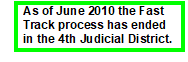
To the benefit of justice, Fast Track was ended in June 2010 and defendants are now given a video advisement hearing, a mandatory restraining order, and set for an arraignment hearing seven days later, which gives them a chance to consult with an attorney.
Another issue is whether Fast Track, and domestic violence laws in general, are acting to deter and prevent, or at least reduce recidivism. Whether the number of repeat offenders is decreasing at the same rate as the total number of cases is some measure of both recidivism and whether those with prior experience in DV court have learned how to manipulate the system. I have not found it possible to document the latter question.
We find that between 2000 and 2010 repeat offenders comprised 32-37% of all Fast Track cases. So current laws and mandatory arrests clearly did not act as a significant deterrent or reduce recidivism over this eleven year period. In 2008 the percentage of repeat offenders jumped to 44% of all cases. While this is apparently a statistical fluke it is still further indication that current laws do not deter domestic violence.
Thus, it is painfully clear that the present system is doing little or nothing to deter repeat offenders and the decrease in total numbers of domestic violence cases is unrelated to any deterrence of repeat offenders. It is extremely unlikely that even more draconian domestic violence laws will reduce recidivism.
We need to fix the problem, not the blame.
It is generally accepted that alcohol is not a primary causative agent in domestic violence but that it does frequently exacerbate existing problems.
The data show alcohol is involved in less than half the Fast Track cases in the 4 th Judicial District. In 2000 alcohol was involved in 47% of all cases. But by 2010 alcohol involvement decreased to just 35% of all DV cases tracked by Fast Track.
It seems unlikely that DV laws are deterring people from drinking, or drunken couples from fighting, but alcohol is involved in less than half the cases seen here.
Perhaps the judiciary and prosecutors in the Seventh Judicial District didn't feel they were doing enough to destroy families and marriages? After a strong beginning of 108 restraining orders per 10,000 citizens in 1998 (Table 39) their totalitarian efforts lagged until 2003 when they managed to jump up again to 106 orders per 10,000 (Table 48). And though they slacked off to 102 domestic violence and abuse cases per 10,000 suffering citizens in 2005 (Table 52) they did pull their draconian average back up to 120 in 2006 (Table 54) after the election of Mryl Serra as district attorney, and to a staggering 133 per 10,000 in 2007. But just 129 persecutions per 10,000 suffering residents occurred in 2008. But Serra bettered the previous record with 134 per 10,000 citizens tortured by corrupt and dysfunctional courts and the district attorney in 2009 (Table 60), although they did drop back to 127 per 10,000 in 2010 (Table 63).
But the judges in this district obviously have a double standard.
In addition, while destroying children, men, and women on a massive scale, the district attorney, Myrl Serra, who took office in 2006, and started work as a deputy in 1998, had been having an adulterous affair that reportedly began in 2001. When the woman's marriage ended as a result of this affair, DA Serra continued to fight with and harass her and she began seeking protection from him in 2008. Visiting Magistrate Jane Westbrook denied her request for a restraining order ruling that there was no threat or act of physical harm to the woman or her daughter. Further, Westbrook stated the harassment did not “meet the statutory requirement.” Of course if the man had not been the district attorney the restraining order would have been granted without question.
Previously, in 2003 Carrie Jewtraw had sought a restraining order against Myrl Serra after he assaulted her and her boyfriend. Of course that request was denied as well
Then on September 20, 2010, just two weeks before he was arrested for engaging in unlawful sexual contact and official misconduct, his former paramour again sought a restraining order against him after he called her in the middle of the night to say “If you want good sex come to Breckenridge 'cause I'm good at sex.” This time visiting Magistrate William McNulty once again refused to grant a restraining order stating the late night call did not amount to unlawful sexual contact or constitute a threat. Of course, any other man who harassed a woman like that would be immediately restrained.
In summary, two women on three occasions tried unsuccessfully to obtain a restraining order against District Attorney Myrl Serra for everything from a physical assault to sexual harassment. Three judges and magistrates in Montrose denied those requests ruling their was not enough evidence of danger to the women, or to the young child of one of them.
Table 63 makes it disgustingly obvious that judges and magistrates of the 7 th Judicial District have no such standards when it comes to issuing protection orders against ordinary citizens.
The Tenth drops to fifth place in judicial dishonor in 2010. However, Table 65 shows the Tenth Judicial District ( Pueblo County) has fully joined the wolf pack of DV persecution. In 2006 they placed first in the state with 146 domestic violence and abuse cases per 10,000 people, a very dubious distinction. And between 2005 and 2010 the number of protection order violations in this district increased from 11 to 663 (Table 62), 60 times as many as before.
The Tenth is nearly five times the size of the adjacent tiny Sixteenth, so the human suffering resulting from this persecution is similarly magnified. For example, the NCVS data suggest that only about 325 criminal domestic violence and abuse cases actually occurred, compared with the 2,037 shown in Table 63 for 2010. The inference is that 85% of these court cases are, at best, unsubstantiated. Bear in mind that the NCVS estimate suggests the actual number of cases per year of domestic violence and abuse that competent prosecutors could prove both mens rea and actus reus beyond a reasonable doubt before a jury of one's peers in the Tenth Judicial District.
The Twelfth Judicial District along Colorado's southern border, always ranks high in our lineup of judicial villains and ranks third in 2010 (Table 63). The Twelfth includes Alamosa, Conejos, Costilla, Mineral, Rio Grande, and Saguache counties. Since 1999 the Twelfth has consistently placed in the top ranks of judicial districts charging men with domestic violence in these already economically-stressed communities.
From Table 65 it is clear that the totalitarian regime in the tiny Sixteenth Judicial District, encompassing Bent, Crowley, and Otero counties in southeastern Colorado, would make Hitler, Lenin, Stalin, and Mussolini proud. In the thirteen years from 1998 to 2010 this once-thriving district of ~31,000 court-ravaged souls has averaged 137 domestic violence and abuse cases per 10,000 citizens. In 2002 the Sixteenth Judicial District issued an astounding 168 restraining orders per 10,000 citizens.
Summing the restraining orders shown for the Sixteenth Judicial District (Table 39 for 1998, Table 40 for 1999, Table 42 for 2000, Table 44 for 2001, Table 46 for 2002, Table 48 for 2003, Table 50 for 2004, Table 52 for 2005, Table 54 for 2006, Table 56 for 2007, Table 58 for 2008, Table 60 for 2009, and Table 63 for 2010), we find that 5,530 domestic violence and abuse cases were processed in thirteen years. No data are available for the years 1994-1997 but a reasonable estimate would be ~1,200. At the current rate of issuing restraining orders it is a simple matter to extrapolate that before 2015 every adult male over the age of 18 in the Sixteenth Judicial District will have been issued at least one restraining order and about two-thirds of the men will have been charged with domestic violence.
One might view this through a radical feminist lens as proof that all men are “batterers” and all women are “victims.” But somewhere common sense should suggest the legal system has run amok.
Marriage and families are quaint relics of the past in this hell hole of “justice” where a state of war appears to exist between the courts and citizens. In fact, the number of divorces in the Sixteenth Judicial District shows a marked decline from 77 per 10,000 citizens in 2004 to 60 per 10,000 in 2010 (Table 77), not because people are staying married longer, but because there are fewer married couples left to get divorced.
When this tabulation of tyrants was begun the 22 nd Judicial District was maintaining an average, or below average number of domestic violence and abuse cases. But a new district attorney has fixed that. The number of DV cases started to go up in 2001 but took an amazing jump in 2006. By 2009 the district had reached a sickening level of 157 per 10,000 citizens (Table 65) but dropped back to 132 per 10,000 in 2010.
The election of a new district attorney, Jim Wilson, apparently heralded the arrival of radical feminism to this rural area. Wilson was either elected on a promise to get tough on domestic violence, i.e., destroy children, families, and marriages, or has some ideological basis for his current vendetta.
It is clear that District Attorney Jim Wilson is hell bent on the ruination of society in Dolores and Montezuma counties.
Another approach to isolating judicial districts that are abusing their discretionary powers with regard to domestic violence was to examine all misdemeanor cases. Table 41 for 1999, Table 43 for 2000, Table 45 for 2001, Table 47 for 2002, Table 49 for 2003, Table 51 for 2004, Table 53 for 2005, Table 55 for 2006, Table 57 for 2007, Table 59 for 2008, and Table 61 for 2009 show selected, population-normalized misdemeanors from data presented by the Colorado State Courts except for the 2 nd Judicial District (Denver). Inasmuch as no consistent correlation was found in eleven years this effort was stopped in 2010.
The assumption was that if a judicial district has a high incidence rate for several categories of misdemeanors as well as domestic abuse and violence, then it is likely that a general problem exists in the society. Misdemeanors, such as offenses against persons or property, fraud, drug use, and underage alcohol use should be prevalent in conjunction with domestic violence in a troubled society. Such a correlation contains the implicit assumption that underage alcohol abuse and drug use would be associated with abusive or broken homes, and that Joe Six Pack would likely get into other kinds of trouble such as bar brawls, besides fighting with his wife or girlfriend. Thus, a high rate of court filings on domestic violence charges would be the result of diligent efforts on the part of the courts and law enforcement in those districts, a job for which they are paid and expected to perform. That did not prove to be the case over eleven years of tabulating such data.
Since all other categories of similar crimes are at or below the state averages except domestic violence it suggests a witch hunt is being conducted for that specific offense. Such actions by law enforcement officials and the courts are generally regarded as an abuse of process and a violation of the equal protection clauses of the state and federal constitutions.
The seven judicial districts showing persistent and continuing high levels of domestic violence and abuse cases, as described above and in Table 65, are compared with other misdemeanors prosecuted in those districts for the years 1999 through 2009 in Table 67. While the data tabulation ceased in 2010 the data are retained for archival purposes.
|
Orders 1 (Abuse only) 2 |
Violence 3 |
Offenses 3 |
Drugs 3 |
Person 3 |
Property 3 |
Fraud 3 |
||
|---|---|---|---|---|---|---|---|---|
|
124 4 |
||||||||
|
1. Values for restraining order column are the sum of all civil and criminal restraining orders. 2. For year 2002 and later, per capita restraining orders for domestic abuse are shown in parentheses and bold if more than one-half of the civil orders are for domestic abuse. 3. Misdemeanors and restraining orders are from Colorado State Court tables. Domestic violence misdemeanors include domestic violence and protection (restraining) order violation cases. 4. Values that exceed state average by more than one standard deviation are shown in bold. |
||||||||
These seven judicial districts encompassed 23% of the 4.4 million Colorado residents sampled (excludes Denver).
As apparent in Table 67, fairly consistent relationships between domestic violence and abuse and other misdemeanors were evident in the Third, Twelfth, and Sixteenth Judicial Districts. These are depressed rural areas ranging in population from 23,000 to 46,000 residents.
Conversely, the evidence seems clear that with regard to domestic violence in the urban Fourth and Tenth Judicial Districts along the Front Range, the courts are engaged in abuse of process under color of law in violation of the equal protection clause of the Fourteenth Amendment of the Constitution.
The same abuse of process occurs in the rural Seventh Judicial District as well. There was no discernible correlation between domestic violence cases that jumped radically upwards in 2002 and other misdemeanors. Rather the actions in the 7 th were associated with the corrupt and criminal district attorney, Myrl Serra, who was arrested on multiple charges in 2010 and removed from office.
Domestic violence is not the only witch hunt possible by police and prosecutors under current laws. Illicit use of drugs may certainly fall under such a heading in some districts where misdemeanor drug use would reflect crackdowns on possession of such drugs as small amounts of marijuana. Despite the attitude of Sheriff Bill Masters of San Miguel County that “...the war on drugs is ludicrous, the criminal justice system is a farce and the law-making arm of government has run amok.” (Denver Post, August 28, 2000, p. B1), the sprawling Seventh Judicial District, which encompasses San Miguel County, had an above average record for drug prosecutions for the four years 1999-2002 (Table 67) though domestic violence and underage alcohol cases were near average. However, after 2002 the emphasis shifted to family persecution in the form of protection orders in this district while the district attorney carried on his sexual hijinks.
The 5 th (2000-2001, 2003-2007), 14 th (1999-2007), and 21 st (1999-2001, 2003-2007) judicial districts all had above average drug prosecutions for three or more years as well, but no relation between domestic violence and drug prosecutions was consistently evident.
One might also expect use of marijuana and underage alcohol offenses to be related. Thus, a crackdown on drugs might result in an increase of arrests for teenage alcohol use, or vice versa. That relationship is only consistent in the Fourteenth Judicial District (Table 41 for 1999, Table 43 for 2000, Table 45 for 2001, Table 47 for 2002, Table 49 for 2003, Table 51 for 2004, Table 53 for 2005, Table 55 for 2006, Table 57 for 2007, and Table 59 for 2008) in the northwest corner of Colorado encompassing the ski town of Steamboat Springs. But, except for 2007 (Table 57), domestic violence prosecutions were consistently at or below average in this judicial district (Table 59).
In stark contrast with the seven districts shown in Table 65, five other judicial districts encompassing 57% of the sampled population of 4.4 million residents consistently had significantly fewer domestic violence and abuse cases than the state average during the sampling period from 1999 to 2009. The numbers are shown in Table 68.
|
First 1 |
|||||||||||||||
|
Eighth 1 |
|||||||||||||||
|
Seventeenth 1 |
|||||||||||||||
|
Eighteenth 1 |
|||||||||||||||
|
1. Municipalities within this judicial district may also issue restraining orders and prosecute misdemeanor domestic violence cases. The state court values given here do not reflect such cases and the stated values might be as much as 20% low, e.g., for 2010 the Eighteenth Judicial District plus municipalities within its boundaries may have issued as many as 60 restraining orders per 10,000 residents. That would still be substantially less than the statewide average of 77. |
|||||||||||||||
There is no reason to believe that the 57% of Colorado's citizens outside of Denver who live in the urban counties that comprise the First, Eighth, Seventeenth, Eighteenth, and Twentieth judicial districts are any more, or less, violent and abusive on average than the residents of the seven districts tabulated in Table 65. The judicial districts in Table 68 encompass large urban (1 st , 8 th , 17 th , 18 th , and 20 th ) populations and the majority of Coloradoans.
Many other factors may account for why these five districts have low numbers of domestic violence and abuse cases reported by the Colorado State Court Administrator's office. For example, the state court does not report on municipal crimes. But some elements can readily be ruled out. For example, it would be ludicrous to consider the district attorney of the First Judicial District from 1998 through 2004 as being soft on the issue of domestic violence. His sister was killed in an act of domestic violence and he raised her daughter and had a daily reminder of the potential effects of this crime while in office. The four other district attorneys are equally likely to fully enforce state law.
Up until 2008 the Thirteenth Judicial District was included in this tabulation but since 2006 its domestic violence and abuse cases have consistently exceeded the state average by more than one standard deviation. That is almost certainly due solely to the election of District Attorney Bob Watson. That appears to be additional evidence that domestic violence cases are based more on ideology than actual occurrences as it is extremely unlikely that criminal domestic violence took a sudden leap upward beginning in 2006 in this judicial district.
When we look at other misdemeanor filings for these five districts (Table 69) the only outstanding features are a high rate of underage alcohol offenses and offenses against property in the 20 th Judicial District. That seems reasonable as the Boulder campus of the University of Colorado is located there and it has an extensive reputation as a party school.
|
Orders 1 |
Violence 3 |
Offenses 3 |
Drug 3 |
Person 3 |
Property 3 |
Fraud 3 |
||
|---|---|---|---|---|---|---|---|---|
|
14 4 |
||||||||
|
16 4 |
||||||||
|
22 4 |
||||||||
|
52 (12) 2 |
24 4 |
|||||||
|
54 (19) 2 |
25 4 |
|||||||
|
51 (15) 2 |
25 4 |
|||||||
|
51 (14) 2 |
26 4 |
|||||||
|
47 (13) 2 |
23 4 |
|||||||
|
48 (12) 2 |
||||||||
|
19 4 |
||||||||
|
22 4 |
63 4 |
38 4 |
||||||
|
65 (12) 2 |
||||||||
|
61 (11) 2 |
||||||||
|
1 4 |
||||||||
|
6 4 |
7 4 |
4 4 |
||||||
|
66 (20) 2 |
||||||||
|
65 (19) 2 |
||||||||
|
60 (16) 2 |
||||||||
|
56 (16) 2 |
||||||||
|
61 (16) 2 |
||||||||
|
64 (13) 2 |
||||||||
|
16 4 |
||||||||
|
22 4 |
10 4 |
|||||||
|
59 (20) 2 |
||||||||
|
60 (22) 2 |
24 4 |
|||||||
|
56 (21) 2 |
21 4 |
|||||||
|
50 (18) 2 |
19 4 |
11 4 |
11 4 |
|||||
|
51 (14) 2 |
22 4 |
10 4 |
||||||
|
60 4 |
||||||||
|
71 4 |
25 4 |
|||||||
|
51 (9) 2 |
59 4 |
25 4 |
||||||
|
44 (9) 2 |
61 4 |
26 4 |
||||||
|
46 (9) 2 |
50 4 |
|||||||
|
46 (8) 2 |
53 4 |
|||||||
|
1. Values for restraining order column are the sum of all civil and criminal restraining orders population-normalized from Colorado State Court tables. 2. For year 2002 and later, restraining orders for domestic abuse are shown in parentheses (RO-DA) and bold if more than one-half of the civil orders are for domestic abuse. 3. Misdemeanors are population-normalized from Colorado State Court tables. 4. Values that are greater than or less than the state average by more than one standard deviation are shown in bold. |
||||||||
The five districts listed in Table 68 and Table 69 encompass the majority of the state's population. Therefore, the sampling of good and bad judges is certainly representative as well.
| EJF Home | Join the EJF | Comments? | Get EJF newsletter | Newsletters |
| DV Home | Abstract | Contents | Tables | Index | Bibliography |
| Chapter 8 — Demographics Of Domestic Violence In Colorado |
| Next — False allegations and burden on the courts by Charles E. Corry, Ph.D. |
| Back — Demographics of domestic violence in Colorado - 2010 |
This site is supported and maintained by the Equal Justice Foundation.