Due Process by Charles E. Corry, Ph.D. and Richard L. Davis, A.L.M.
This site is copyrighted, supported, and maintained by the
Equal Justice Foundation.
|
EJF Home
|
Join the EJF
|
Comments?
|
Get EJF newsletter
|
Newsletters
|
|
DV Home
|
Abstract
|
Contents
|
Tables
|
Index
|
Bibliography
|
|
Chapter 6 — Domestic Violence And The Law
|
|
Next — What do police and courts think of domestic violence laws?
|
|
Back — Domestic violence versus civil rights
|
It is well settled that, quite apart from the guarantee of equal protection, if a law impinges upon a fundamental right explicitly or implicitly secured by the Constitution
[it]
is presumptively unconstitutional.
Harris v. McRae 448 US 297 (1980)
Index
Introduction
Plea bargains by Richard L. Davis, A.L.M.
Your rights under due process
Does the court have jurisdiction in your case?
Jurisdiction over persons or things
Standing
Example
You're male, you're guilty
Introduction
Top
Under the Fifth and Fourteenth Amendments to the United States Constitution, citizens are guaranteed
“due process”
under the law and the term has the same meaning in both. However,
“due process of law”
has never been a term of fixed and invariable content. Neither the federal or any of the state constitutions have made any attempt to define what is
“due process of the law.”
The term is not susceptible to an exact, precise, comprehensive, or concrete definition. Part of the grandeur of the concept is that it is too broad to admit of a short definition that embraces every situation, and that any definition must depend on the relation a particular act bears to the fundamental law that limits legislative power.
Judge Thomas Cooley
is credited with stating that due process of law in each particular case means such an exertion of the powers of government as the settled maxims of law permit and sanction, and under such safeguards for the protection of individual rights as those maxims prescribe for the class of cases to which the one in question belongs. Where doubt exists, law and government are encumbered to come down on the side of individual liberty.
Due process is ensconced in such concepts as fair play, consistency, the right to a fair and impartial trial on the facts in a case, and other fundamental principles of liberty and justice that lie at the base of all our civil and political institutions.
Equal protection for all citizens, as well as due process, is guaranteed under the Fourteenth Amendment. The concept of
equal protection
means that you should be treated the same as everyone else under
all
statutes, rules, and regulations.
Due process was so rudimentary to the systems of government proposed by our forefathers that it has been incorporated into the constitutions of all the states, including the Colorado State Constitution in
Article II Section 25:
“Due process of law.
No person shall be deprived of life, liberty or property, without due process of law.”
At the beginning of our national history it was written in our earliest state constitutions that
“all men are born free and equal, and have natural, essential, and unalienable rights.”
Over time, the phrase
“all men”
began to be defined as
“all Men,”
meaning
“mankind,”
a word including
“women, children, and minorities.”
This expanding concept was interpreted as granting to all men and women, regardless of race, or ethnicity, or national origin, or age, the right to equal treatment under all the laws and the rules and regulations promulgated under them.
Sex equality is guaranteed under the Colorado Bill of Rights in
Article II Section 29:
“Equality of the sexes.
Equality of rights under the law shall not be denied or abridged by the state of Colorado or any of its political subdivisions on account of sex.”
That expansiveness resulted in the greatness of the reputation of our country.
Our pinnacle of greatness has, unfortunately, not lasted. It has been diminished mainly through mass hysteria. Rambunctious bureaucracies and legislatures, both grand and petty, under the cloak of seemingly noble causes such as stopping domestic violence, preventing the neglect of children and sexual abuse, have trampled on the essential rights of citizens to due process and equal protection under the law.
One of the most common responses to this hysteria has been the removal of children from their families without due process, without affording either the children or their parents the right to equal protection.
VOCAL
estimates over 500,000 children have been so taken in the past decade. Yet over thirty years ago, our United States Supreme Court, in
Gault vs. Arizona 387 U.S. 1 (1967)
— a case in which a sheriff, without notice or a warrant to arrest, took a 15-year old boy from his parent's home in their absence — recognized this action as violating the essence of our rights and overturned Arizona law on this issue. But the significance of the Gault decision has been buried in the past three decades by ideologues who ignore civil liberties.
And what does this mean to you as an individual, trembling in the living room while facing jackbooted police who have pushed their way into your home? In theory, all branches of government
must
respect the following due process rights.
Plea bargains by Richard L. Davis, A.L.M.
Top
A Bureau of Justice Statistics study documents that approximately 94 percent of all convictions are not the result of a trial, instead the conviction is the result of a plea bargain
(Boland, et al., 1982).
A plea bargain is generally accepted by the courts as a criminal procedure that involves negotiations between the defendant and his attorney on one side and the prosecutor on the other. The defendant is allowed, presumably without coercion by the prosecution to plead
“guilty”
or
“no contest”
to a crime. Often this is a result of the prosecution agreeing to lessen the severity of charges or the dismissal of some of the charges, or probation rather a jail sentence. This process is designed to be to the benefit of the defendant, the prosecution, the defense attorney, and the public good.
In
Santobello v. New York
the U. S. Supreme Court agreed that plea bargaining, if properly administered, is to be encouraged. In fact there is general agreement that there are not the resources to provide constitutionally-guaranteed trials to all defendants. Although this circumvents the many defendants' rights guaranteed by the Constitution, few will argue that this process is not fair when it is being fairly and judiciously administered.
Plea bargaining requires judicial consent concerning the procedure to ensure that it is properly, fairly and equitably administered. Defense attorneys may advise their clients to agree to a plea bargain when they are sure they do not have a chance to win their case. Prosecutors are often willing to bargain because it clears their case load and provides them with a guilty plea. However, because the U. S. Supreme Court has held that a guilty plea constitutes a conviction it has been generally accepted by courts across the nation that defendants be allowed the opportunity to talk with an attorney before they admit guilt. What kind of judicial system would we have if the only attorneys the defendants see are those who are working against their rights and whose job it is to find them guilty?
To protect defendants against hastily arranged or unjust pleas the
Federal Rules of Criminal Procedure
requires that before a judge can accept a plea bargain the court must assure itself that the defendants have been afforded their rights. The judge shall inform the defendant:
1. Of the complaint against the defendant;
2. Of any affidavit filed therewith;
3. Of the defendant's right to retain counsel or to request the assignment of counsel if the defendant is unable to obtain counsel;
4. Of the general circumstances under which the defendant may secure pretrial release;
5. Inform the defendant that the defendant is not required to make a statement and that any statement made by the defendant may be used against the defendant;
6. Inform the defendant of the right to a preliminary examination;
7. Allow the defendant reasonable time and opportunity to consult counsel; and
8. Detain or conditionally release the defendant as provided by statute or in these rules.
In 1973 the National Advisory Commission on Criminal Justice Standards and Goals recommended plea bargains be abolished
(Schmalleger, 1999).
• There was concern that the process of entering a plea bargain might change the goal of the criminal justice system to be administered fairly and equitably.
• There was concern that those working within the criminal justice system may be more interested in defending their institutional interests than in the rights of those who appear before them looking for justice.
Society continues to believe that the courts, first and foremost, seek justice. Society continues to believe that the court, above all else, honors honesty.
Perhaps contemporary society might think again?
Richard L. Davis
Your rights under due process
Top
1. You have the right to receive notice of charges in a timely fashion.
2. You have the right to be presumed innocent until proven guilty.
3. You have the right to be presented with a search warrant. Without one, it is unlawful for the police or any government official to enter your home, search, or seize your property.
4. You have the right to be presented with a warrant for your arrest unless the police actually saw you commit a crime or have probable cause to believe you have committed a felony based on their personal investigation at the scene.
5. You have the right to a writ of habeas corpus if you are arrested and imprisoned.
6. You have the right to remain silent and speak with an attorney before making any statement to the authorities.
7. You have the right to confront your accuser and to cross-examine witnesses against you.
8. You have the right to refuse to answer questions that might incriminate you.
9. You have the right to a transcript of all proceedings, hearings, and trials though you will have to order and pay for them.
10. You have the right to appeal any findings of a lower court.
11. You have the right to subpoena witnesses and any documents or other evidence that may support your position or contradict evidence presented against you.
12. You have a right to a trial by jury in all criminal matters and in civil cases where the value in question exceeds $20 by an impartial jury of your peers.
13. You have the right to the protection and provisions of the Constitution of the United States and the State Constitution.
14. You have the right to protections expressly created in statute and case law precedent.
15. You have the right to equal protection of the law regardless of race, creed, color, religion, ethnic origin, age, handicaps, or sex.
16. You have the right to a remedy, by recourse to the laws, for all injuries or wrongs that you may receive in your person, property, or character.
17. You have the right to justice, without being obliged to purchase it; completely, and without any denial; promptly, and without undue delay; in conformance with the laws.
Does the court have jurisdiction in your case?
Top
One of the fundamental questions of due process is whether a court has jurisdiction over a defendant in a criminal case or a respondent in a civil case.
Jurisdiction
refers to the power of the court to decide a case, i.e., to render a decision that will be recognized and enforced by authorities and other courts.
This is not a trivial issue as the Equal Justice Foundation repeatedly hears of cases where judges have arrogantly assumed jurisdiction in a case beyond the territory of their court or where no personal jurisdiction existed, e.g., a county court issuing a default paternity judgement against a citizen of another state, or a wife seeking a divorce in a location where she is not a resident.
Note that if jurisdiction is an issue is must be challenged immediately.
There are three main types of judicial jurisdiction, personal, territorial, and subject matter:
•
Personal
jurisdiction is an authority over a person, regardless of his location.
•
Territorial
jurisdiction is an authority confined to a bounded space, including all those present therein, and events which occur there.
•
Subject matter
jurisdiction is an authority over the subject of the legal questions involved in the case.
For jurisdiction to be complete a court must have a concurrence of both subject matter
and
personal jurisdiction
or
subject matter
and
territorial jurisdiction. Of course a court may have personal, territorial, and subject matter jurisdiction as in a case involving federal law and a resident citizen.
Conversely, a state court has no territorial jurisdiction if the charges are violations of a federal law. Similarly, a federal court has no initial jurisdiction if the case involves state law. Further, a municipal judge can only rule on cases involving the municipal code in the territory of the city where he has jurisdiction.
Territorial jurisdiction is critical on the principle that courts can only enforce laws that are within the boundaries of their authority, usually defined as
“an area of land that is governed by an entity who can hold those residing therein accountable for following specific laws.”
Courts may also have jurisdiction that is exclusive, or concurrent, or shared. Where a court has exclusive jurisdiction over a territory or a subject matter, it is the only court that is authorized to address that matter. Where a court has concurrent or shared jurisdiction, more than one court can adjudicate the matter. Where a concurrent jurisdiction exists in a civil case a party may engage in
“judge shopping”
by bringing the case to a court which they presume would rule in their favor. And it is in such cases where the issue of jurisdiction is most likely to be abused.
If a judge has proper jurisdiction with regard to the subject matter of the law in the case before them, there is also the question of whether they have personal jurisdiction over the defendant or respondent. That question commonly arises in civil cases where the respondent lives in another state or outside the territorial boundaries of the court. This requirement is commonly abused by courts in cases involving domestic abuse restraining orders. For example, a woman in Weld County, Colorado, was granted such an order against a man in Florida. In other cases involving paternity and child support it is common for judges to enter default judgements, i.e., the man is never notified to appear at the hearing, against men in other states. Colorado judges routinely issue such default judgements at the behest of the child support agency (CSE) against men in New Mexico and other states, and judges in California, and other states, routinely issue default paternity judgements against men in Colorado. In one case, a judge in Orange County, California, issued a default paternity judgement against a Colorado man who had been sterile from birth.
In our experience, the issue of personal jurisdiction is often violated.
Thus, if you are being sued by someone living in another state then the first question to ask is whether the court has both subject matter and personal jurisdiction over you? While the court may have subject matter jurisdiction based on the type of lawsuit or criminal act, it may not have personal jurisdiction over you if you do not live in the territory the suit was filed in, have never traveled to that state or territory, or the visit or residence was many years ago and any statute of limitations has expired.
Obviously a plaintiff or prosecutor must file a complaint with the court within the statutory time limit of the alleged violation or crime. But a respondent or plaintiff should always check that the statute of limitations has not expired as a basic step in their defense.
Jurisdiction over persons or things
Top
Personal jurisdiction
(in personam) is the power of a court to adjudicate the personal legal rights of parties properly brought before it. In personam requires that the court not only have jurisdiction over the subject matter of the action, but also that it have territorial jurisdiction over each party to the action. Due process of law requires appearance or service of process, that is adequate notice of pendency of the lawsuit be given, before the defendant can be personally bound by any judgment.
Jurisdiction over the parties (personal jurisdiction) usually relates to the question of whether someone from another state, Alaska, New York, or Nevada can be forced to come to the forum state where the lawsuit was filed
,
e.g., Colorado, to defend against the lawsuit. The existence of personal jurisdiction depends upon a sufficient connection between the defendant and the forum state to make it fair to require defense of the action in the forum.
To establish personal jurisdiction the plaintiff or prosecutor must demonstrate that the court has personal jurisdiction based on any of the following theories:
(1) Presence
(2) Domicile
(3) Consent
(4) Minimum contacts
(1) Presence,
i.e., being served with a copy of the summons and complaint while physically present in the forum jurisdiction.
The physical presence of a defendant in the forum is a sufficient basis for acquiring jurisdiction over him, no matter how brief his stay might be.
(Pennoyer v. Neff, 95 U.S. (5 Otto) 714, 24 L.Ed. 565 (1877).
(2) Domicile
(residence) alone is a basis for exercising jurisdiction over an absent domiciliary.
(Milliken v. Meyer, 311 U.S. 457, 61 S.Ct. 339, 85 L.Ed. 278 (1940).
To wit, a person may always be sued for all claims, regardless of where they arise, in their state of permanent residence or, in the case of a corporation the state in which it is incorporated.
(3) Consent to personal jurisdiction.
A defendant who has not been personally served in the jurisdiction can nevertheless voluntarily appear and submit himself to jurisdiction. In such cases defendant is said to have
“consented”
to jurisdiction.
Can consent be obtained in advance of any lawsuit being filed or can consent be implied?
Hess v. Palowski, 274 U.S. 352, 47 S.Ct. 632, 71 L.Ed. 1091 (1927)
says yes. A state can legislate that a nonresident motorist using its highways be deemed to have appointed a local official as his agent to receive service of process in any action growing out of the use of the vehicle within the state. However, the state must provide actual notice to the nonresident defendant.
Consent also means if you sign the fee waiver form and return it to the plaintiff that automatically gives the court jurisdiction over you. As long as you do not sign the waiver, you are not giving the foreign court jurisdiction. So why voluntarily agree to be sued or set foot in the forum state if you have never had previous contact with it?
(4) Minimum contacts.
Having sufficient dealings or affiliations with the forum jurisdiction that make it reasonable to require the defendant to defend a lawsuit brought in the forum state. Hence, a defendant who has never set foot in California may nevertheless be subject to valid personal jurisdiction so as to be compelled to defend a lawsuit in California provided that he has minimum contacts with the forum state such that compelling him to appear and defend in the forum does not offend traditional notions of fair play and substantial justice.
(International Shoe Co. v. Washington, 326 U.S. 310, 66 S.Ct. 154, 90 L.Ed. 95 (1945).
The due process clause does not permit a state to exercise personal jurisdiction over an individual or corporation with which the state has no contacts, ties, or relations. Conversely, the law may specify what contacts, ties, or relations suffice to give a state personal jurisdiction. For example, Colorado law states it has personal jurisdiction over a paternity judgement if the man and woman had sexual congress within its borders even though neither reside there.
Standing
Top
In civil suits the Petitioner must also establish they have
“Standing,”
i.e., a valid cause of action to bring the case before the court in which the suit is filed. This means that in the first-filed documentation seeking a hearing the Petitioner must allege facts that, if proven true, would give the court jurisdiction to make the orders sought.
If the filed documents do not contain such allegations of fact that would give the court the power to issue the orders demanded, the action is by definition vexatious and frivolous. This is the case for any civil action and the Respondent can make this challenge instead of making an unconditional appearance.
Example
Top
The issue of a court's jurisdiction is not trivial and should never be ignored. All too often we find arrogant judges and magistrates assume they have jurisdiction over any poor soul who appears in their courtroom. The case of
People v. Culpepper In the Interest of M.C., a Child — Case 00 JV 578
is a sad reminder of power-mad magistrates (now a district judge) like Dinsmore Tuttle in Weld County, Colorado. Unfortunately, her actions are far from isolated and it behooves any respondent or defendant to challenge whether the court has jurisdiction in their case if there is the slightest doubt.
Further, if there is any chance the case may be appealed, whenever there is a possibility jurisdiction or standing may be in question it must be entered into the record of the trial court.
You're male, you're guilty
Top
The problem is that the rights tabulated above are universally ignored in moral crusades against domestic violence and abuse, child abuse, or sexual abuse, as well as in other causes such as the War on Drugs.
Without notice or evidence men are forced from their homes and children, arrested without a warrant often on nothing more than hearsay, their homes are searched without pretense of authority to do so, they are jailed without hearing or trial, publicly reviled for crimes they have not committed, their property seized without redress, denied the right to confront their accuser and obtain witnesses in their defense, and are deemed guilty until they can prove themselves innocent.
A horrifying example of the arbitrary and capricious exercise of government is inadvertently exposed in an article by
Gover and others (2003)
describing the establishment and operation of a criminal domestic violence court in Lexington County, South Carolina, under a grant to the sheriff's office from the
Violence Against Women Office
of the Department of Justice. On p. 115 of their paper,
Gover and others (2003)
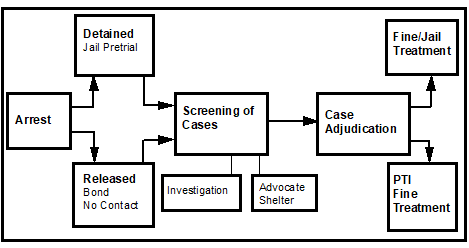
provide a diagram outlining the intervention strategy the sheriff and special DV court take with all who are accused of domestic violence in Lexington County. Their diagram is reproduced here as Table 12.
A moments review of what they regard as
“justice”
for DV defendants in Lexington County will show that once you are accused and arrested, which is mandatory, you are punished.
There is no exit for the innocent or falsely accused
(Table 12). And the term
“convicted offender”
isn't used by
Gover and others (2003).
All defendants are automatically punished. Take for example the following description (p. 115):
“...These referrals were accompanied by a strict weekly follow-up on
defendants'
[emphasis added]
progress in the treatment program. If
defendants
[emphasis added]
failed to comply with their treatment conditions, then a bench warrant would be issued by a judge for their arrest and their suspended jail sentence would be imposed.”
Table 12: Flow diagram for the treatment of defendants in the Lexington County, South Carolina criminal domestic violence court describing the intervention strategy (Gover and others, 2003).
Top
All non-felony battery cases of domestic violence are processed through the specialized domestic violence court in Lexington County, South Carolina. Since its inception in November 1999, over 2,500 cases were
“processed”
through 2002. Of these cases, approximately 13% of the defendants were female. And the mean time in jail for all defendants is five days.
However, as
Gover and others (2003, p. 116)
note, these draconian policies have had no measurable deterrent effect on domestic violence. Arrests for both simple and aggravated assault are basically unchanged in their sample after the specialized DV court was implemented though they claim recidivism is down. However, that claim is weakly supported and the sample size is very small.
All these actions violate the concept that under due process the government is without right to deprive a person of life, liberty, or property by an act that has no reasonable purpose, and which is so far beyond the necessity of the case as to constitute an arbitrary exercise of governmental power. Further, the general rules of our system of jurisprudence for the security of private rights have been destroyed.
Throughout history such actions by a State have been the cause of violence, not the cure.
Top
|
EJF Home
|
Join the EJF
|
Comments?
|
Get EJF newsletter
|
Newsletters
|
|
DV Home
|
Abstract
|
Contents
|
Tables
|
Index
|
Bibliography
|
|
Chapter 6 — Domestic Violence And The Law
|
|
Next — What do police and courts think of domestic violence laws?
|
|
Back — Domestic violence versus civil rights
|
This site is supported and maintained by the
Equal Justice Foundation.
Last modified 9/7/26