This site is copyrighted, supported, and maintained by the Equal Justice Foundation.
| EJF Home | Join the EJF | Comments? | Get EJF newsletter | Newsletters |
| DV Home | Abstract | Contents | Tables | Index | Bibliography |
| Chapter 1 — Charged With Domestic Violence? |
| Next — A criminal defense attorney's view of the domestic violence industry |
| Back— Penalties for a domestic violence conviction |
Chief Justice Warren Burger, US Supreme Court
Hiring an attorney — Buyer Beware
A competent criminal defense attorney is essential
Infidelity likely basis for false allegations
List of attorneys in other states
Ten reasons to worry about your attorney
Never is the ancient axiom of Buyer Beware more important than when attempting to find and hire a competent attorney either in a criminal or civil case.
The legal profession is rife with incompetents, crooks, and moral degenerates, and the “profession” is a state monopoly. Rates for private attorneys as of 2011 generally run between $300 and $500 per hour and any contact with them, i.e., a one-minute phone call, is billed as one-quarter hour of their time. For these horrendous costs you will get someone who likely majored in arrogance but logic was not a required course. Note that I rarely meet an attorney who has the education I would expect of a college sophomore. Yet I am repeatedly contacted by citizens who have naively put their trust in some shaman licensed by the state bar association, whom they had never met or investigated, but they have put their lives, families, and careers in this pompous fools hands and given them thousands of dollars as a retainer without any guarantee of performance. In fact, many people have reported their attorney dropped them when they wouldn't do what the attorney wanted them to do, e.g., accept a plea bargain, but kept the retainer. Or the attorney continues and papers the case, then drops them without any resolution of their case as soon as they run out of money.
Time after time it has been brought to my attention that any attorney attempting to go against their state bar association is attacked from within and all too often disbarred. Two examples come immediately to mind, Linda Kennedy in Virginia for her essay
Holodeck Law — Litigation Vortex
accurately describing how the courts actually function. Another case is that of
Barbara Johnson,
an Andover, Massachusetts, lawyer who fought for the rights of fathers, campaigned for governor in an antique fire engine, and drove a hearse to Washington, D.C., to protest divorce laws, and was then barred from practicing law in 2006. And these are but two of over a dozen cases I know of. So when you ask why it is so hard to find an attorney to defend your rights, remember that your state bar association is working against you.
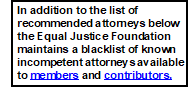
Below, the Equal Justice Foundation maintains a fairly short list of attorneys whose competence has been demonstrated or reported to us. However, the Equal Justice Foundation also maintains a much longer blacklist of incompetent or worse attorneys whose malfeasance has been reported to the Foundation.
The most common problem is that an attorney takes a substantial retainer, $5,000 to $50,000, and then pushes their client into a plea bargain/guilty plea for a crime they did not commit simply because the attorney is too lazy, incompetent, a crony of the DA or judge, mentally unstable, drunk, crooked, etc., to take the case to trial and zealously defend their client as attorney ethical standards demand. Time and time again we've been told the defendant's attorney coerced them into a plea bargain without any attempt to inform them of the lifetime consequences of a conviction. All too often we've heard the client wasn't even informed a plea bargain had been entered until after the fact. Or worse, the attorney pushes their client into a plea bargain in a domestic violence (DV) case claiming the plea doesn't include a DV rider and their client ends up with a DV conviction. And make no mistake, a plea bargain of any kind is a criminal conviction and it will not magically disappear from the public record no matter what lies attorneys, prosecutors, and judges tell you.
It is clear that lawyers, by and large, are drawn from the bottom of the gene pool regarding ethics and morals, and judges are generally pulled from the middle to bottom half of the attorney pool.
Another constant cri de couer I hear concerns perjury and why is it condoned? Worse, lawyers frequently suborn perjury, particularly in divorce and domestic violence cases. Bok (1999) has pointed out that once a lie enters a forum, the forum becomes irrational. And irrational well describes the behavior of many attorneys and judges today.
Then there are attorneys who judge cases solely on the basis of their ideological or religious beliefs. Those I encounter in this category are usually neo-Marxist radical feminists (redfems) who hate all men. Catharine McKinnon is but one example. But there are many male attorneys, usually in the district attorneys office, whose practices are based more on the voices in their heads or religion than law and justice. Mike Nifong comes to mind in this category.
Sheer stupidity and gross incompetence are also often reported to me. Drunkenness and drug abuse are known. A number of women have described being propositioned by attorneys they consulted and many cases of attorneys being paid by sexual favors in divorce cases have been recounted. Sexual assault by attorneys isn't unknown, the case of Colorado's 7 th Judicial District Attorney Myrl Serra is but one example.
Another recent example (2022) is the suspension of 11 th Judicial District Attorney Linda Stanley's license by the Colorado Supreme Court for failure to complete mandatory continuing legal education.
Obviously if an attorney has previously been disbarred, suspended, or is otherwise so stupid, crooked, and incompetent that even the attorney protective association, i.e.,the state attorney regulation board, has recognized it then you probably don't want to hire them for your legal problems. But finding the blackmarks on an attorneys record can be very difficult.
A citizen can take it for granted that an attorney doesn't know all the law. With hundreds of thousands or more laws on the books it is impossible for anyone to know all the law and ramifications. As a result, as in any profession, attorneys must specialize.
In seeking competent legal representation the first step is to find a lawyer who specializes in the area where help is needed. For example, a divorce or family-law lawyer isn't likely to be effective in a criminal case, and one who says he can be is almost certainly incompetent or ineffective in both areas. A criminal defense lawyer will not be of much help, and likely will do great harm, in issues involving probate and wills, and so on. Corporate law is a world unto itself, and on and on. Thus, that good-ole-boy country lawyer of yore can be a citizen's worst enemy by taking on cases where they are completely out of their league.
One good test of attorney competence is that after consulting with them they will refer you to another attorney whose specialty covers the legal problem you have, or they will review their experience with your type of case and provide a résumé and outline their applicable trial experience. And that must be done before a retainer is paid.
Conversely, I often hear complaints from citizens about attorneys who tell them they have no case that will stand up in court. In my opinion, that is the best kind of lawyer, one who doesn't waste one's time and money promoting false hopes and creating more problems than they can possibly solve.
Good attorneys, being rare, are busy people. So it is often difficult to contact them or schedule an appointment. That is to be expected. But when an attorney:
• Doesn't show up for a hearing or trial;
• Doesn't provide copies of discovery, motions, and other critical documents to their clients;
• Doesn't bother to subpoena witnesses or file critical motions;
• Hasn't bothered to read correspondence or the case file,
• Doesn't bother to notify their clients that they need to appear on given date and time in specified court;
• Tells their client that attendance at a hearing isn't necessary; or
• Shows up unprepared at a hearing or trial,
A recent case where an attorney who was listed by the Equal Justice Foundation in Colorado Springs didn't bother to show for a restraining order hearing, and a permanent restraining order was then imposed on their client, in part prompted this addition. That was not the first time this had happened and that group of attorneys was quickly moved to our blacklist.
Looting trust funds held in client's names isn't uncommon and conservatorship and guardianship fraud has become a favorite way to make a living for several attorneys I'm familiar with.
Conyism can be considered a given and attorneys generally defer to local judges. Thus, it is usually a good idea to engage an attorney whose primary practice is outside your judicial district. You will pay a bit more for their travel time but you are much more likely to get the zealous advocacy in court that you are paying for. In a number of cases I have heard that local attorneys pressured their clients to accept plea bargains basically because they were afraid to upset the judge by taking the case to trial. This isn't the only place where that occurs. Worse, when a client has refused to accept a plea bargain, the attorney has dropped them but kept the retainer.
And before you make a final choice it is suggested you disabuse yourself of the idea of hiring what is colloquially known as a heavy hitter.
Good attorneys may be hard to find but they are essential in nearly every case before the bar. There are even some fair and honest judges, however long the odds are against the one you have to appear before actually is.
As a basic premise, don't hire the first lawyer you talk to, or a friend or relative recommends, and be sure their personality matches yours closely enough that you can work with them.
While time may be short, consult with at least three attorneys if at all possible before hiring one. And be sure their primary practice covers your case and that you've done a background check on your pick. An find out how many jury trials each attorney has done in the past five years.
It is also advisable whenever possible to hire an attorney from outside your judicial district.
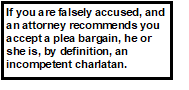
Beware of any lawyer who promises to win. An honest attorney will give you an honest opinion about your chances and lay out options. However, in a criminal case, particularly cases involving charges of domestic violence or sexual abuse, it is essential that you plead not guilty and demand a jury trial. A criminal defense attorney who tries to push you into a plea bargain, especially if they haven't clearly explained the lifelong consequences of a guilty plea, is incompetent by definition.
And follow the steps outlined below...
We strongly recommend that you plead “Not Guilty” at any hearing if charged with domestic violence. There is no easy or fast way out of the situation. Your only way out of this is likely to be a jury trial.
If you plead guilty, accept a plea bargain, or plead no contest to any of the charges against you, the conviction will be virtually impossible to change when you finally discover the horrendous and deleterious effects this has on your life. And by accepting a plea bargain you surrender your rights to an appeal of your conviction.
Note that both the district attorney and an incompetent defense attorney will almost always attempt to get the accused, you, to accept a plea bargain.
The prosecutor can, and will, lie and add on multiple charges to the initial police report in an attempt to bluff you into accepting a plea bargain. For example, the police may arrest you for 3 rd -degree misdemeanor assault involving domestic violence. However, at your arraignment the charges will commonly become felony assault, false imprisonment, child abuse, criminal mischief, and etc., none of which the prosecutor could possibly prove to a jury. These add-on charges are solely intended to scare you into accepting a plea bargain. Third-degree misdemeanor assault involving domestic violence may look like an easy out when it looks like you could face felony assault charges. Don't believe their bluff.
Also note that if you accept a plea bargain that is an admission of guilt and you surrender your right to appeal.
A plea bargain is an easy victory for the prosecutor and saves incompetent and dishonest attorneys the time and effort of preparing for trial even though (s)he still collects their fee. Thus, the attorneys both win and you lose in a plea bargain because the law, C.R.S. § 18-6-801(3), does not allow a plea bargain to a charge that does not involve domestic violence. If your attorney suggests a plea bargain, unless you are unquestionably guilty, first get rid of them as fast as you can. Next, we would like to know about it, particularly if the attorney appears on the lists below because they will be removed and placed on our blacklist.
You are the one who knows your case best. No one can help you unless and until you communicate the essentials of the issues to them. And it is virtually impossible for anyone to understand the problems or issues in your case without a timeline. We have seen defendants waste literally thousands, if not tens of thousands of dollars because they did not put together a coherent timeline and expected, and paid their attorney to do the work for them. However, a timeline seems to be the hardest thing to get out of people who approach the Equal Justice Foundation for assistance (note that for personal assistance you must first join ).
Unfortunately, most people in these situations develop or have PTSD, together with Legal Abuse Syndrome, and those conditions often make it almost impossible for them to develop a timeline on their own. Note that a timeline is not a narrative, or a rant, it is simply a dispassionate tabulation of events with dates, time, and location. Any investigator will need to know what, when, where, and who in order to proceed.
Talking about the problems with a friend or relative may help the PTSD but most don't understand how dysfunctional the justice system has become and often think you are exaggerating, or even crazy. Our suggestion is to get help from a relative or good friend who does understand your situation to tabulate the events, or even better (and cheaper than an attorney) is to seek help from an ADA advocate.
• Don't expect to make a complete timeline in one sitting. Important events will surely occur to you later.
• Don't expect others to read your mind!
And that applies particularly to your attorney. And when they've spent all your money and you are still incoherent, they will often drop you, keep the discovery and what they've put together, as well as your money, and you have little recourse. In our experience attorneys generally will not make a timeline of events for you and, as a result, they usually provide a very poor defense in your case. If, by some good fortune, your attorney will make a timeline for you it will cost you many thousands of dollars for their time and will be incomplete as they cannot know your case and the events therein as well as you do.
Timelines are also quite useful for keeping track of deadlines, filing dates, statutes of limitation, etc. in your case.
To make any sense out of your case, anyone who looks at it will need a timeline of events describing what happened, when, where, and with whom. Note, however, that
a timeline is not a narrative,
it is simply a list of events with a short, i.e., date, time, case number, one or two sentences at most, statement about each event. Put any applicable documents or narrative in a separate looseleaf and reference them in the timeline. Do the same with applicable phone messages, emails, letters, etc. so as not to clutter the timeline.

By a timeline we mean a sequential tabulation of events listed in order by date (and time if important) with a succinct description of the event. A crude example of a timeline is given in Table 1.
Making notes on a 3x5 card will be a big help in developing your defense, or you can do it on a computer word processing program. Alternatively a sample form is available here . In many cases it may well be worthwhile for you to purchase software to help you develop a timeline and case history. One package we've used is Case Map and associated Time Map by Lexis Nexis. Make sure you keep backup copies away from your home or apartment where she can't get at them or destroy them by wrecking your computer or trashing your card file.
But a timeline is useless if all you do is rant and rave about the wrongs done you, the injustice, how dysfunctional the courts are, what incompetent liars police and prosecutors are, how much you miss the kids, etc. That is already known from thousands of previous cases. If you can't rationally state the facts get an ADA advocate to help or you are almost certain to lose.
Be sure to include all past criminal cases, suicide attempts, psychiatric exams and diagnoses, drug or alcohol abuse, and the outcome for all parties involved as completely as you can. For example, if you or she have been involved in a domestic violence case with a previous partner, that is critical information for an attorney.
Gather together all receipts, telephone records (cell phone companies can tell where you were when a phone call was made), traffic tickets, credit card statements, airline tickets, doctor or dental visits, day planners, appointment records, toll slips, gas purchases, motel receipts, car rentals, emails sent, date-stamped photographs, and any other documentation of where you were and what you were doing during any time periods in question. Assemble this documentation in chronological order and associate the documentation with the timeline events.
Another benefit of putting together a timeline is that many men have found they couldn't possibly have been present and done what they are charged with. For example, in the example timeline above the ex-wife claims he “slapped her and called her names” on November 22, 2001. In review that is Thanksgiving and he was in Oshkosh, Wisconsin, with his parents while she was in Denver, and he has airline tickets and car rental receipts, as well as the testimony (or affidavits) of his parents and siblings to prove it. Cell phone records can also be used to prove one was in a given location at a given time.
When you suspect problems might arise we also strongly recommend the use of appropriate surveillance methods or a private investigator to document the events. Use of a private investigator is critical if there is a restraining order against you.
Your attorney will also need any information you have on how to contact the individuals involved, e.g., the court, case number, phone number, names of judges, other parties, e.g. wife or girlfriend, wife's new boyfriend, arresting officers, opposing counsel, guardian ad litem (GAL), potential witnesses, social services case workers, evaluators and other court cronies, psychiatrists or psychologists, kids, paternity testing lab, etc. Remember, if the attorney or his paralegal have to assemble this information it will cost big bucks and can't possibly be as complete or accurate.
An attorney cannot defend you against something he doesn't know about and he most definitely won't appreciate finding out some damaging information from the prosecutor or opposing counsel. So be as honest and complete as you possibly can in putting together the timeline. And don't be afraid to add to the tabulation if you've forgotten something initially, which is virtually sure to happen.
When you have your thoughts in order and a timeline to give you perspective take a moment and define what you want the outcome to be. Be sure and discuss that desired outcome with your attorney to see if it is realistic and achievable. One of the best measures of any attorney is whether they give you a dispassionate, honest evaluation of your situation and your desired outcome.

Almost daily we hear from men and women who tell us they couldn't afford an attorney and took a plea bargain. Now the real costs of their conviction are evident they want to find a lawyer.
It just doesn't work that way!
You must defend yourself with everything you have from the day you are charged. And don't count on a public defender to be of much help. Even in the unlikely event they are competent attorneys, each public defender will have from several hundred to a thousand cases. While your life is on the line, it's just one case out of a thousand to them unless you are charged with a serious felony or homicide.
Likely you have already lost your home and children by this point and getting them back is not going to be cheap, fast, or easy. In fact, under current laws it may well be impossible. Along this line you should also definitely read the following article by Paul Stuckle, Esq., discussing a criminal defense attorney's view of the DV industry.
The court and treatment costs if you plead guilty will be nearly equal to the cost of an attorney and the almost certain loss of your employment will make an attorney's fees look cheap. If you are innocent the up-front cost of an attorney will be nothing compared to the lifetime costs of copping a plea. But a basic problem is finding a competent attorney the first time out.
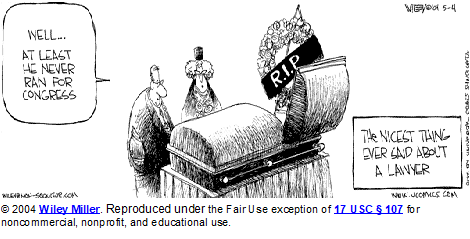
Nearly all attorneys lack the education one might reasonably expect of a sophomore science or engineering student. However, they all seem to major in arrogance at law school. So don't think the first attorney you talk to is the man, or woman, who will save your life for you. The odds are 9 out of 10 that any attorney you encounter will be an incompetent, ignorant, arrogant, money grubbing, south-end of a northbound donkey. Take your time and follow the suggestions below to get safely through the minefield of attorney selection.
Going into this you might also want to familiarize yourself with the concept of Holodeck Law and the associated litigation vortex.
If the actions against you are part of a divorce, remember it is very much in the interest of at least one of the attorneys, probably hers, to keep the level of antagonism between the two of you at a maximum level to increase the legal fees. Mediation is usually a much cheaper alternative than divorce court if she is amenable to that approach.
Be aware that there is a very good chance she has filed domestic violence charges, or taken out a protection order against you in order to cover up her infidelity.
The most prevalent situation where domestic violence charges are filed in a divorce that have been reported to the Equal Justice Foundation is after the husband finds evidence his wife is having an affair . So, even if you don't know whether she is unfaithful, it might be well worthwhile to hire a private investigator to check.
In fact, you might find a private investigator a very useful person to hire to help you prove your innocence.
If you have children there is a one-in-three chance that you are not the father. Maternity is a fact; paternity is an opinion. So see the section on paternity fraud and get DNA testing done on all the children as soon as possible. You certainly don't want to pay child support for children that are not yours, though the courts may force you to anyway. But it is much better to know up front and such knowledge can play an extremely important role in defending yourself from false allegations.
Accept the fact that you are considered guilty until you can prove your innocence, due process will not be followed, perjury is acceptable, and hearsay will be used against you. Thus, we consider Dean Tong's book Elusive Innocence a must read if you have been falsely accused in any domestic situation, including child or sexual abuse. Other items of use are Dean Tong's article on the abuse excuse . Also, see False Allegations and you should follow their:
• First steps in your defense.
If you have children be aware that the woman is very likely to charge you with child abuse and sexual abuse, as well as domestic violence or abuse in a custody battle.
If you are bonded, have a security clearance, work for a public agency such as the fire department, carry a weapon, work with or transport hazardous materials, or use explosives, you are in particularly bad trouble. Job reference checks on COcourt will also show you have a record so it may be difficult or impossible to get new employment. We have encountered a number of cases where men had intended to become policemen, sheriff's deputies, firefighters, truck drivers, etc., and vindictive and vengeful wives and girlfriends have charged them with domestic violence in order to destroy their hopes and ambitions.
Before hiring any attorney we suggest you check out the A-Team's Web site. We strongly suggest you spend some time with the A-Team's Top Ten lists:
• Top Ten Things to do When Falsely Accused
• Top Ten Qualities to Look for In a Lawyer
• Top Ten Questions to ask Your Lawyer
• Top Ten Things Dads Seeking Custody Need to Know
The A-Team is made up of trial consultants, lawyers, psychologists, medical doctors and other experts. You will probably need more than one these specialties no matter where you turn for help.
Good criminal defense lawyers are intelligent, honest, experienced, responsible, available, cautious, caring, sensitive about cost, hard to find, and have excellent oral and written communication skills. Unfortunately, it bears repeating that most attorneys major in arrogance in law school, and haven't the education one would expect of a sophomore engineering or science student. It seems to be the latter class of attorneys who are most likely to become judges but they certainly are not what you want to defend you. So use the Top Ten lists above as a checklist to measure any and all attorneys you are considering for your defense. We maintain a blacklist of attorneys who have proven dishonest or incompetent and, for EJF members and contributors, we will verify whether or not an attorney you are considering appears on that blacklist or not if you send us an email request.
See also the extensive list of attorneys, law firms, and judges who have been reported to have been disciplined by the State of Colorado for unethical conduct, who may be residents of Colorado but were disciplined in another state, who may have been arrested, incarcerated, indicted, sued for malpractice, or have been charged with unethical and/or criminal conduct, who cannot practice law in the State of Colorado for one reason or another, who have violated the Supreme Law of the Land, or have engaged in conduct which tends to defeat the administration of justice or to bring the courts and the legal business into disrepute, etc. Reasons or details about the disciplinary action are not given. However, if the attorney you are considering appears on this list may we suggest you look elsewhere.
Now that you have a realistic idea of what you are faced with, take a hard look at yourself. Are you really innocent? Are you prepared to defend yourself through a battle that will last at least six months, though more likely years, and probably cost between $2,500 and $10,000? Six figures for attorney fees aren't rare. Is it any wonder the legal system likes these laws so much?
Conversely, if you don't defend yourself you will likely spend at least $1,000 for the treatment program mandated by the court, and an additional $400-$500 in court and other costs. You are also out the cost of new housing, wardrobe, etc. because the protection order is permanent.
As it can be virtually impossible to avoid violating the protection order if the woman is vindictive, you could also be facing jail time. So $2,500+ for an attorney up front may look like it would have been a worthwhile investment down the road. But once you have pled guilty, plea bargained the charge, failed to appear at a hearing, or tried to ignore these actions in the hope that they will simply go away, you have virtually no chance to make changes to the lifetime sentence you are under.
Or are you willing to accept a lifetime sentence and slink away from everything you own and have worked for? Society has evolved the term “Deadbeat Dad” for men who do that although usually the more proper description is “Driven-Away Dad.” Either way you lose everything you have ever worked for.
If, like us, you believe that your freedom and children are as precious as life itself and must be defended, you will need an attorney. If your children are involved, you will have very few options without an attorney, and those precious little people have already been taken from you.
Other sources of help can be found in the listed Web sites and you will want to do some law research. Your attorney is going to need your help and it is essential that you are intimately familiar with the laws under which you have been charged. Links are provided to the relevant laws in Colorado but you will have to do your own research if you live in another state or country. Do the research!
And, yes, we realize these laws are making attorneys rich. Long ago Dickens' observed “The one great principle of the...law is to make business for itself.” We are working to get the laws changed but you are in trouble now.
In the longer term, a contribution to the Equal Justice Foundation will help as well. This information may be free to you but there are multiple expenses involved in providing it.
Disclaimer: The site, www.dvmen.org, the Equal Justice Foundation and anyone affiliated with it, are not responsible for the litigator's efforts or results in your case should you retain one or more of the attorneys listed in Table 2 or Table 3.The Equal Justice Foundation does not receive any financial remuneration or compensation in kind for these listings.
Colorado's attorneys are licensed and disciplined by the Supreme Court. The court's attorney regulation system, funded by attorney registration fees, polices the profession. In addition, the court oversees the State Court Administrator, Board of Continuing Legal Education, Board of Law Examiners, Commission on Judicial Discipline, and Unauthorized Practice of Law Committee.
Findings and opinions about miscreant attorneys are printed monthly by the Colorado Lawyer (click on month of interest then scroll down to Colorado Disciplinary Cases). The actions published are only those cases in which Disciplinary Counsel has taken formal action. To view attorney discipline involving diversion and private admonitions online you must be a member of the Colorado Bar Association.
To find out how many grievances are filed against an attorney you may be concerned about, call the Attorney Regulatory Board at (303) 893-8121 and specifically ask how many complaints were filed against that lawyer. They will give that information on the phone but it is not published.
In practice Disciplinary Counsel acts primarily as an attorney protective association with only rare cases known where unethical or incompetent attorneys are taken to task, i.e, the attorney was convicted of a federal or state felony. Even in the rare cases where disciplinary action is taken, it seldom amounts to more than a slap on the wrist and the weak disciplinary action is usually kept confidential.
To help defendants and others avoid the worst of the lot, attorneys listed in Table 2 and Table 3 are known to, or advertise themselves as representing men charged with domestic violence or abuse. We ask all readers to recommend attorneys for addition to these lists. And any attorney who would like their name added to this list is urged to contact us at webmaster@ejfi.org.
Conversely, if any attorney in these lists known to you has not represented you, or someone you know, aggressively and fairly we would like to know that as well. They will be removed. You may also want to review Ripoff Report to see if an attorney you are considering is listed there.
If contacted by a member or contributor to the Equal Justice Foundation about a particular attorney, whether on these lists or not, we will provide any history of that individual's performance we might be aware of.
The Colorado Criminal Defense Bar also maintains a list of attorneys who will work on an income based sliding scale. While we have very limited experience with most attorneys listed there, if you do not qualify for a public defender we suggest you contact one of the attorneys on their list. Means to evaluate any attorney you consider are given above.
|
Works primarily with veterans.Retired CW5 Army aviator, served two tours in Iraq as Blackhawk Medevac pilot and tour as a helicopter pilot in Vietnam with Marine Corps. |
||||||
|
Our highest recommendation for handling domestic violence cases. Bibik is also licensed in Michigan and will accept cases in other states as well. Will also undertake legal malpractice suits against other attorneys in selected cases. |
||||||
|
Highly recommended. Practice includes family law, divorce, mediation, arbitration, and adoption. |
||||||
|
Focus is criminal defense, especially assault and DV. Over 12-years experience defending men and women accused of DV ranging from 3rd degree assault to 1st degree murder. |
||||||
|
Primarily handles DV cases, is a former DV prosecutor, and has an excellent reputation for acquittals. Office in Vail and Eagle County phone (970) 476-0268. In Denver area call (303) 809-3425. |
||||||
|
See list of DV and anger management providers in Colorado Springs area. |
||||||
|
Specializes in domestic violence cases. Nights and weekends (719) 660-5862. |
||||||
|
See his writeup on dealing with domestic violence charges. |
||||||
|
Family law focusing on men's rights in divorce, property division, child custody, maintenance, child support, contempt, domestic violence, restraining orders, paternity, and post-judgment issues. |
||||||
|
Personal injury attorney but noted for his work on civil liberties. |
||||||
|
Our highest recommendation for handling domestic violence cases. Bibik is also licensed in Michigan and will accept cases in other states as well. Will also undertake legal malpractice suits against other attorneys in selected cases. |
||||||
|
Emphasis is on the representation of fathers in custody or parental responsibility disputes within the Denver Metropolitan Area. |
||||||
Our objective in Table 2 has been to provide a list of attorneys covering the entire State of Colorado who are competent and known to handle DV cases. We have not been able to contact every attorney on the list. The completeness of the information on an attorney is a crude indication of how much contact we have had with them.
Under the current domestic violence and abuse laws virtually every lawyer dealing in family law and divorce has had some experience with criminal defense of violence or child abuse charges. However, in dealing with criminal defense there is no substitute for experience trying cases in front of a jury. Look for an attorney who has experience as an assistant district attorney prior the entering private practice, or who has many years doing criminal defense.
An attorney should only be retained after you have examined their curriculum vitae (CV) or résumé. You should be certain that the lawyer has defended cases similar to yours in a trial successfully. Be certain the attorney you choose has recent and continuing trial experience and is willing to take your case to trial if necessary Many attorneys claim a success if they plea bargain a case to a lesser charge. In domestic violence or abuse cases, in our experience, that is almost universally a very bad outcome for the accused, and is simply an easy out for a lawyer as they get paid without having to do the work.
Some of the attorneys in Table 2 and Table 3 litigate in criminal court only. Some only litigate in family court. Still others specialize in juvenile court or appeals. Be aware that if you are charged with domestic violence, child abuse, or sexual abuse (SAID) during a divorce you will probably need more than one attorney, and probably at least one investigator as well. This isn't going to be cheap but the sentence is for life if you are convicted or plead guilty or nolo contendre (no contest).
You may also want to investigate the Match program run by the Denver Bar Association to find an attorney in Colorado who is willing to work at reduced rates for those who don't qualify for a public defender but lack the means to pay normal rates for an attorney. Fees are negotiable but participating attorneys typically reduce their fees by ~50% for those who qualify. Available only to those individuals who earn less than $23,200 plus $3,200 per dependent per year. The address is 1900 Grant Street, Suite 950, Denver, CO 80203-4336, telephone: (303) 860-1115.
While this Web site deals primarily with the problems of domestic violence and related charges of marital rape, false allegations of child or sexual abuse, and the other myriad weapons of revenge current laws have placed in the hands of Colorado women, we very commonly hear from men and women outside this state.
A common plea is where do they find help? It was a daunting task to assemble the list of Colorado attorneys given in Table 2 who might help these hapless individuals. It is far beyond our capabilities to make a national database of attorneys who work in this ever expanding area of the law. However, we are willing to list those attorneys in other states who make this area of the law a specialty in the hope that some victims of these horribly unjust statutes may be helped.
We have also been helped in the task of assembling attorneys outside Colorado by Dean Tong. Attorneys listed in Appendix D of his book Elusive Innocence have been included here with his permission.
If you know of other attorneys you would care to recommend, or you are an attorney who works with such cases, contact us at webmaster@ejfi.org and we will be pleased to add you to the list in Table 3.
|
Specialty is gun law rather than domestic violence per se. Has personal experience with false allegations of domestic violence. |
||||||
|
Weinberg is former Orange County DA. Firm also handles immigration law problems. |
||||||
|
See his writeup on how to defend yourself against false accusations of domestic violence. |
||||||
|
Parents rights. Attorney for Navarro case of paternity fraud. |
||||||
|
Specializes in palimony law, including cohabitation agreements, and representation of plaintiffs and defendants in lawsuits between unmarried cohabitants. |
||||||
|
Deals with false accusations of rape and domestic violence, false memory syndrome, Munchausen syndrome by proxy, and similar cases throughout southern California. |
||||||
|
For those who fear gender discrimination in divorce court and dread losing all contact with their children, their homes and possessions, and where protection orders and allegations of domestic violence are being used as a weapon. |
||||||
|
Specializes in father's rights. |
||||||
|
Family law and false allegations. See writeup of his work against columnist Lori Handrahan. |
||||||
|
Experience in custody disputes, child protective services, etc. David operates the Citizens Justice Institute. |
||||||
|
Hession's Web site is an excellent source of information on what you face when protection orders are filed against you. You should definitely read his section on how to fight false protection orders. |
||||||
|
No longer a practicing attorney but web site is an excellent source. |
||||||
|
False allegations, false accusations, recovered memories, sexual abuse, sexual assault, child molestation, rape of child, sexual offender profiles, pedophiles, supervised visitation, custody, fathers' rights, men's rights, spousal rape, sexual harassment, and similar areas of the law. |
||||||
|
Relentless defense of all criminal charges and accusations, including murder, rape, domestic violence, assault and battery, indecent assault & battery, armed robbery, breaking and entering, drunk driving, and armed assault by a courtroom savvy criminal defense lawyer. |
||||||
|
Our highest recommendation for handling domestic violence cases. Also licensed in Colorado and will undertake cases in other states as well. Will also undertake legal malpractice suits against other attorneys in selected cases. |
||||||
|
Recover Kid — Rapid and economical recovery of child victims of parental kidnaping. |
||||||
|
Retired Marine Corps Gunnery Sergeant. Helped set up veteran courts in Minnesota. |
||||||
|
His book Domestic Violence: The 12 Things You Aren't Supposed To Know is highly recommended. |
||||||
|
Provides assistance to military who need legal counsel when facing court martial. Rates are on a sliding scale and much less than most other lawyers. |
||||||
|
Offers advice on how to represent yourself pro se. See home page for details. Also see his brief on debtor's prisons and child support laws. |
||||||
|
Specializes in nursing home and elder abuse cases. Works throughout the U.S. |
||||||
|
Crusader against corruption as a two term District Attorney of Waco, McLennan County, Texas. See his sample Motion to Dismiss (Word) if arrested for DV on hearsay because the neighbors, or some stranger called the police, and your wife or girlfriend doesn't want to prosecute. Can easily be modified for your state and case. |
||||||
|
David Guinn was the attorney in the precedent-setting case of Dr. Tim Emerson. |
||||||
|
Normally accepts only cases where he feels real injustice exists and his client is the victim of the injustice. |
||||||
|
Area of specialty: Criminal defense of false allegations of child sexual assault, child abuse, and domestic violence. See his article A Criminal Defense Attorney's View of the DV Industry. |
||||||
|
Family law and father's rights attorney with personal experience from the litigant's side before he became an attorney. Licensed mediator to save many from going to court. |
||||||
|
Near Washington, D.C., working throughout Northern Virginia in all areas of family law, legal ethics and malpractice cases, mediation, and wills. Interstate and international child custody cases are a particular field of expertise. |
||||||
|
Former JAG attorney now in civilian practice exclusively handling military law cases. |
||||||
|
Contact by phone or fax preferred. Scott is the author of a number of articles on gender bias and DV. See Real Family Law web site. |
||||||
We also compile information on attorneys regarded as incompetent or worse by their clients. Please contact us for any information we may have on a particular attorney, or let us know if your attorney has sold you down the river, proven utterly incompetent, or is generally useless so that we can pass the information along when asked. You may also want to review Ripoff Report to see if an attorney you are considering is listed there.
We also like to hear when an attorney has done their job extremely well.
The following instances were discovered during the Mercury News' review:
1. An attorney told his client not to worry that there were no witnesses at trial — they could be called on appeal.
2. An attorney told the prosecutor about other crimes his client had committed but had not been charged with.
3. After repeatedly showing up late or failing to appear, an attorney finally offered an explanation near the end of the trial: The problem was his alcoholism.
4. An attorney was arrested at the entrance to the courthouse when a vial of illegal drugs fell out of her purse.
5. An attorney refused to meet her client at the jail because she said she was not paid enough to do so.
6. After an attorney called her client a “jerk” in court, she assured the judge there was no problem — she had represented plenty of jerks.
7. Because the attorney had paid him with a bad check, an investigator told a defendant calling from jail he was no longer working on the case.
8. An attorney called the defendant to the witness stand at the preliminary hearing, unaware that the prosecutor could then use that testimony against the defendant at trial.
9. A defense lawyer told the judge before sentencing that he had nothing to say on his client's behalf.
10. A defense lawyer was arrested after appearing in court to represent a client because the lawyer was suspended by the state bar at the time.
| EJF Home | Join the EJF | Comments? | Get EJF newsletter | Newsletters |
| DV Home | Abstract | Contents | Tables | Index | Bibliography |
| Chapter 1 — Charged With Domestic Violence? |
| Next — A criminal defense attorney's view of the domestic violence industry |
| Back— Penalties for a domestic violence conviction |
This site is supported and maintained by the Equal Justice Foundation.